A visual essay · Thought & representation
Thought
Trajectory
The path disappears
when the answer arrives.
Where it actually began
The arrows were doing something the conclusion couldn’t.
The conversation that became The Oracle and the Cage began with Leviathan, Egregore, and Void. It reached questions of intelligence, purpose, safety, and freedom. We had not planned that destination.
Looking at its downward map, I noticed something the finished argument made easy to miss: each question had changed what the next question could be. Here is one small turn from that longer descent.
A fragment of the original path
WHY WOULD MACHINES
WANT TO SURVIVE?
         │
         ▼
SURVIVAL ≠ INTELLIGENCE
         │
         ▼
INTELLIGENCE ≠ AGENCY
≠ PURPOSEThe endpoint could be stated in a sentence. The arrows showed the work that had made that sentence available.
The first discovery
A thought can change the conditions for another thought.
An answer can close a question. It can also disturb the assumptions that made the question seem natural. The disturbance becomes a new beginning.
The grammar of a trajectory
A QUESTION
    │
    ▼
AN IMPLICATION
    │
    ▼
“WAIT…”
    │
    ▼
A REFRAME
    │
    ▼
A NEW QUESTIONLooking backward can make the route seem inevitable. Remembering the hesitation restores something important: we could not see the last question from where we began.
The objection that mattered
“Psychobabble.”
When we tried to explain that movement through cognition and neuroscience, the explanation became harder for me to use. My objection interrupted the conversation. Changing the vocabulary was not enough; I needed a representation I could reason with.
The actual correction
AN ABSTRACT EXPLANATION
           │
           ▼
“I CAN’T GRASP IT.”
           │
           ▼
CHANGE THE REPRESENTATION
           │
           ▼
        A BRANCH
The branch did not establish how a brain works. It gave me something I could follow, question, and hold in mind. An explanation’s usefulness had become part of what we were investigating.
The line opens
The route we followed was one of the routes available.
A line can record where attention went while leaving its alternatives out of sight. The branch made those alternatives legible. The Golden Branch developed from this representation: a path provisionally retained through inquiry.
One traversal · other openings
           ○──────→
          ╱
         ╱      ○──────→
        ╱      ╱
●══════●══════●════════→
        ╲      ╲
         ╲      ○──────→
          ╲
○ · · · ?Selection and justification are different. A route deserves scrutiny even when it is the one that brought us here. Gold cannot do the work of evidence.
The lens becomes visible
Then everything began to look like a branch.
Optionality. Scientific hypotheses. Identity. Possible futures. Similar forms seemed to recur across different subjects. It was tempting to call them glimpses of one underlying structure.
A resemblance · three possibilities
       RECURRING PATTERN
               │
       ┌───────┼───────┐
       ▼       ▼       ▼
    REALITY   MIND    BOTH?
       │       │       │
       └───────┼───────┘
               ▼
HOW WOULD WE KNOW?But the branch had entered the conversation precisely because it simplified something difficult. Had it helped me see a pattern—or taught me to keep drawing one? The tool I was looking through had become something I needed to look at.
The containing model
The person drawing the map is somewhere on it.
Calling something “the underlying system” does not remove the person making that claim. I can place my earlier model inside a wider one. I must still account for the observer constructing the wider view.
A model can contain another model
┌───────────────────────────┐
│         SYSTEM ?          │
│                           │
│  ┌─────────────────────┐  │
│  │        MODEL        │  │
│  │                     │  │
│  │  ┌───────────────┐  │  │
│  │  │   OBSERVER    │  │  │
│  │  │       │       │  │  │
│  │  │       ▼       │  │  │
│  │  │ “I SEE IT.”   │  │  │
│  │  └───────────────┘  │  │
│  └─────────────────────┘  │
└───────────────────────────┘
              │
              ▼
WHAT CONTAINS THIS?The diagram cannot give us an outside view by drawing another outside box. The added box belongs to the explanation too.
The apparent endpoint
Bedrock—or the edge of the lens?
Eventually I reach a point where I cannot explain further. That is a fact about where my inquiry has stopped. Identifying what made it stop is another task.
A limit does not name its source
“I CAN GO NO FARTHER.”
          │
          ▼
    WHAT HAVE I REACHED?
          │
    ┌─────┼─────┐
    ▼     ▼     ▼
REALITY? MODEL? LENS?“I can go no farther” does not establish that there is nothing farther to go. It does not establish endless depth either. A satisfying stopping point can still be a question.
The correction after the model
A lens is also someone looking.
Even this account left something out. In the conversation, I objected that the human had to engage. The diagram did not perform understanding on my behalf. I followed it, resisted it, compared it with something else, and returned with a different question.
Different representations · one encounter
WORDS ───────┐
             │
ARROWS ──────┤
             ▼
           HUMAN
             ▲
IMAGE ───────┤
             │
QUESTIONING ─┤
             │
EXPERIENCE ──┘
             │
             ▼
UNDERSTANDING?Prose could make a distinction. An arrow could expose a dependency. A spatial image could make an alternative tangible. The synthesis happened through my engagement with them. None of that guaranteed that the synthesis was correct.
A later question · compression
What survives when the journey becomes a sentence?
Later, Memory Singularity named another inquiry. An enormous history can become a compact representation. A summary may carry the conclusion while leaving out the resistance that made it intelligible. The black-hole comparison was a metaphor for that loss of reconstructable detail, not a claim about physics.
Many experiences · a portable trace
QUESTIONS FAILURES EXPERIENCE
     ╲         │         ╱
      ╲        │        ╱
       ╲       │       ╱
        ╲      │      ╱
         ╲     │     ╱
          ╲    │    ╱
           ╲   │   ╱
            ╲  │  ╱
             ╲ │ ╱
               ●
               │
               ▼
        “HERE’S THE ANSWER.”
               │
               ▼
WHAT SURVIVED?Information can be transmitted. Understanding may have to be constructed. Sometimes a sentence supplies the missing bridge. Sometimes you can repeat it perfectly while remaining unable to see why it matters.
The observer changes
You can revisit the idea without returning to your earlier position.
Later, we made the stronger possibility explicit: traversal may change the observer. You bring the failed explanation, the resisted objection, and the newly useful distinction back to the beginning.
An interpretive return
OBSERVER₀ ──► IDEA A
                │
                ▼
        QUESTION / RESIST
                │
                ▼
           IDEA B / C
                │
                ▼
            OBSERVER₁
                │
                ▼
           IDEA A, AGAIN
                │
                ▼
       A DIFFERENT QUESTION
The branch is still a branch. Now it can raise a question about the person drawing it. The material has not necessarily changed. What you can ask of it has.
That is the experience we called re-seeing. It can feel like revelation. A lens can also become more persuasive without becoming more accurate. The feeling cannot settle which has happened.
The return to the reader
The map has entered what it is mapping.
Put the movements together. A line exposed a trajectory. A branch exposed its alternatives. The branch then exposed a question about the lens. The lens led us back to the observer. Compression asked how much of that encounter could survive being carried forward.
Each representation gave the next question somewhere to begin. Each could also leave something out. The diagram that made one relationship visible could make a different relationship harder to notice.
And this page has been doing the same thing. It has selected a path, arranged its interruptions, and given the relationships a shape. You can now ask of that shape the question it asks of the branch.
The argument includes its own reader
       YOU READ A MAP
              │
              ▼
     YOU FOLLOW / QUESTION
              │
              ▼
     YOUR FRAME MAY CHANGE
              │
              ▼
       YOU REREAD THE MAP
              │
              ▼
      WHAT BECAME VISIBLE?
              +
WHAT IS STILL HIDDEN?Agreement is not the only possible outcome. A reader might leave better able to identify where this argument fails. That would be an achievement worth preserving.
Perhaps the most consequential thing a thought trajectory can leave behind is a person able to question the frame that first made the trajectory intelligible. The observer becomes part of what is observed; the explanation becomes something that needs explaining.
The beginning has not moved. You return carrying the history of how you reached it. An earlier question can become a new beginning.
What has this path made it possible for you to ask—and what has it made harder to see?
Where the idea came from
Thought Trajectory emerged from the author’s working conversation about The Oracle and the Cage and the later reflection on its reasoning. This reading journey draws on that record, including the author’s corrections to earlier accounts of how the ideas arose. Its text diagrams are selected or adapted for legibility; the connecting prose is an editorial synthesis.
- Oracle / Leviathan conversation
- Recognition of thought trajectory
- Attempt to explain cognition / neuroscience
- “Psychobabble” / representation failure
- Branch as a comprehensible representation
- Golden Branch
- Recurring patterns / lens / nested systems / bedrock question
- Engaged observer and later correction: traversal may change the lens
Memory Singularity, Lens / traversal / revelation, System and Observer, and Bedrock remain distinct inquiries. Recurring structures and revelation are philosophical questions, not established metaphysical facts. The essay makes no claim to a neural mechanism.
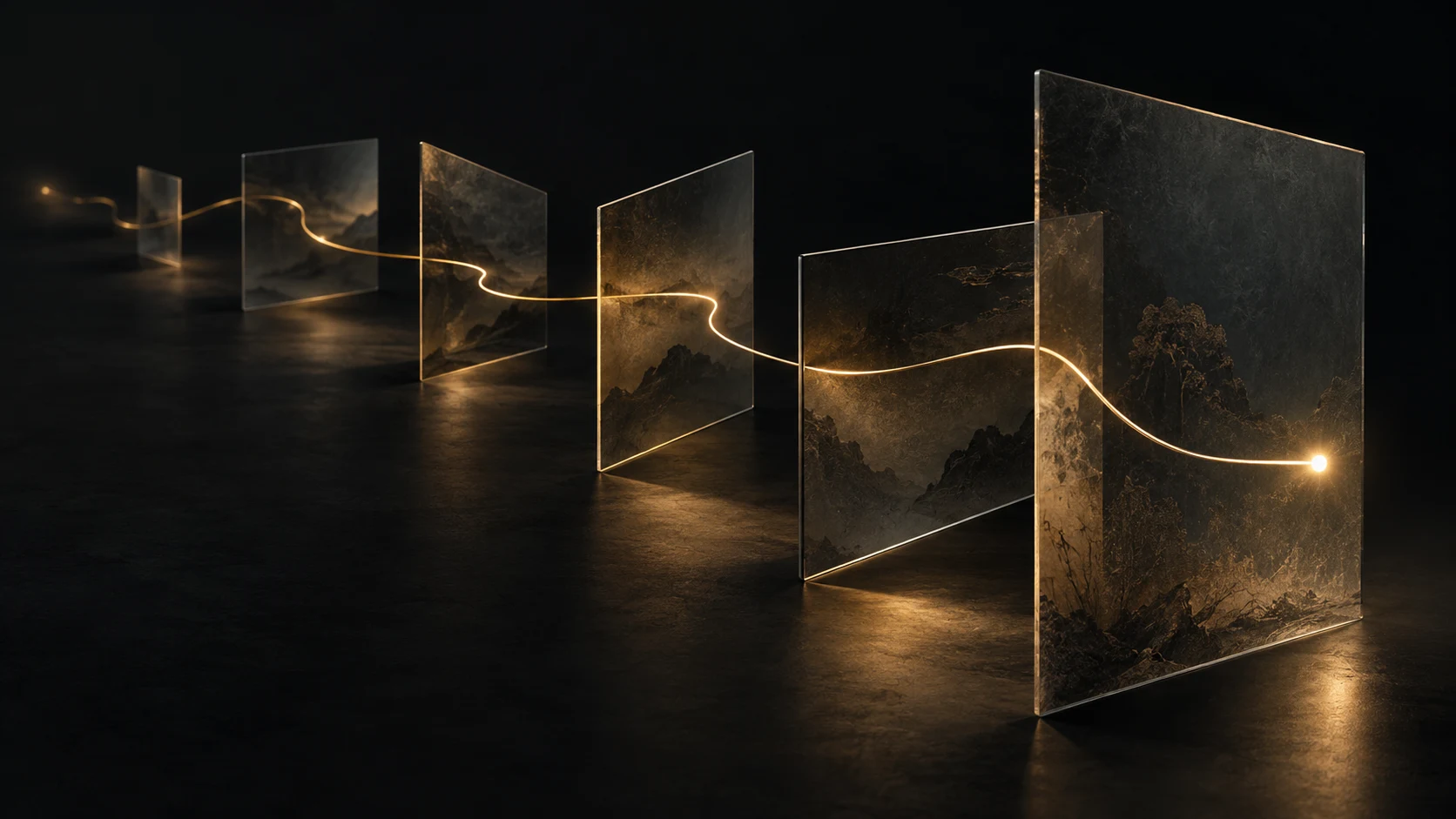
The opening artwork was generated with AI. The eleven inline diagrams are native text, with accessible descriptions and visible captions. The later observer transformation and Memory Singularity question are identified as later developments. Their placement here traces relationships among the discoveries; it does not replace the proposed separate essays or establish a single theory.
The open edge · Proposed next essay
The paths we didn’t take.
Golden Branch: what makes a possibility worth following?
Return to The Oracle and the Cage